- What the speckled surface actually is
- The burner dial is the whole game
- Oil is a seasoning, not a requirement
- Searing without the smoke alarm
- Eggs, the honest benchmark
- The saucepan on low: milk, grains and patience
- The thermometer, not the clock
- Two rules the fire service repeats
- Mistakes that look like pan problems
- A week on one set
A nonstick pan is usually sold as a shortcut, and then used like the stainless pan it replaced: burner on high, oil poured until the bottom shines, food in while the surface is still deciding what temperature to be. The shortcut survives this treatment for a few months and then quietly stops being a shortcut. The truth is friendlier and slightly more demanding: a coated aluminum pan rewards a different technique, and the technique is easy to learn because almost all of it is about doing less. Less heat, less oil, less prodding, less scrubbing. The habits below come from the same granite sets we make and cook on.
What the speckled surface actually is
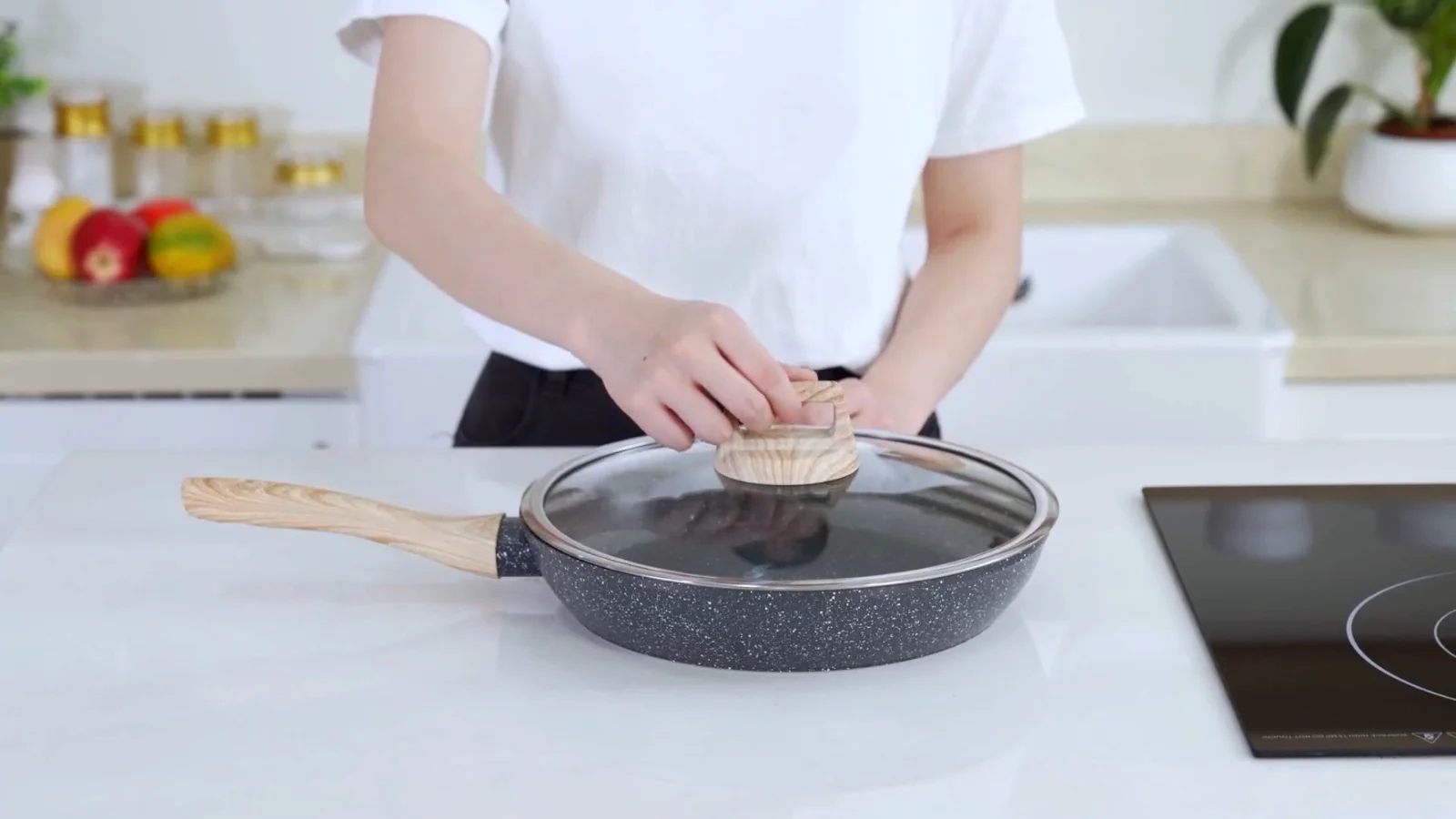
The finish that names our granite line is not stone, and no honest maker will tell you it is. It is a nonstick coating built up in several layers and bonded to the die-cast aluminum body at high temperature, with a mineral speckle that gives the surface its granite look. The engineering promise sits in the layers: a release surface on top, reinforcement beneath it, and a primer that grips the metal so the whole stack stays put through years of heat cycles.
We specify the coating in negatives, because that is where the real information is: made without PFOS and PFOA, without lead and without cadmium. The regulatory picture behind coatings like this is public and worth two sentences. Nonstick coatings on cookware sold in the United States sit inside the FDA food-contact framework, and the agency's published review of that category describes coatings polymerized and bonded to the pan at very high temperatures, a process that drives off the small migratable molecules. The FDA's conclusion is that negligible amounts migrate to food. The source list at the end links the agency's own pages, with the dates we read them.
What the layers ask from you in return is a single habit: respect the surface. The coating is the part of the pan that does the daily work, and it is the part that your spatula, your burner dial and your washing-up routine either preserve or grind down. Every section below is a variation on preserving it.
The burner dial is the whole game
Die-cast aluminum responds fast. That is its virtue: turn the dial and the pan follows within moments, which is exactly what you want when a sauce threatens to catch. The same speed is the beginner's trap, because the reflex from thin stamped pans, where high heat mostly got lost through the wobbling base, will overshoot badly on a cast body with a full induction disc feeding it evenly.
The rule that replaces the reflex: medium is the new high. On most stoves, the middle of the dial brings a SODAY pan to frying temperature in about two minutes, and past the middle you are cooking for the smoke point of your oil rather than for the food. High heat has exactly two jobs on a coated pan, boiling water in a pot and preheating a pan you are about to sear in, and even the second one stops at medium-high.
| The dish | The dial | What the pan is doing |
|---|---|---|
| Eggs, omelets, crepes | Low to medium-low | Gentle, even set, the coating releases without color |
| Pancakes, grilled cheese | Medium-low to medium | Browning without scorch rings, edge matches center |
| Sauteed vegetables, stir-fry | Medium | Fast surface moisture loss, no steam puddle |
| Chicken breasts, fish fillets | Medium | Golden crust, cooked through before the outside darkens |
| Steak, chops | Medium-high, preheated | A real sear, the one job for the top of the dial |
| Sauces, grains, milk | Low, lid on | The vented glass lid holds a simmer you can see |
One more habit borrowed from professional kitchens: preheat dry or with the oil already in, but never walk away from an empty pan on a live burner. An empty coated pan on high heat is the fastest way to age a coating, and it is also the setup for the kitchen-fire statistics in the last section.
Oil is a seasoning, not a requirement
On bare steel, oil is infrastructure: it fills microscopic valleys so protein does not weld to them. On an intact nonstick surface that job is already done, and oil goes back to being what it should be, flavor and browning. A teaspoon swirled in a warm pan covers eggs for two. A tablespoon handles a stir-fry. Butter behaves beautifully on the coating, but add it to a warm pan rather than a hot one, because the milk solids that make butter delicious burn earlier than oil.
Two practical notes that save coatings. Aerosol cooking sprays are convenient and slightly hostile to nonstick surfaces: their emulsifiers polymerize into a sticky lacquer at the edges of the heat zone, a residue that builds up and reads as "my pan lost its nonstick" when it is actually wearing a varnish of old spray. Pour or brush oil instead. And when a recipe says "heat oil until shimmering," believe the shimmer, not the clock: on responsive aluminum the shimmer arrives sooner than recipes calibrated for cast iron expect.
The release you paid for lives in the coating, not in the oil. Spend oil on flavor and let the surface do its own job.
Searing without the smoke alarm
The persistent myth says nonstick pans cannot sear. What they cannot do is sear the way a steakhouse range does, at temperatures that would also punish the coating. In the band the pan is happy in, medium-high, preheated two to three minutes, a light film of high-smoke-point oil, you get a genuinely good crust on steak, chops, chicken thighs and salmon, with dramatically less smoke than bare metal produces.
The mechanics of a good nonstick sear are mostly patience. Dry the surface of the meat, because surface water spends your heat on steam. Lay the piece in and then leave it: the same release that makes eggs easy means the steak will unstick itself when the crust is formed, and pulling early is the only way to tear it. Turn once, finish to temperature, and rest it off the heat. Our 11-inch frying pan and the deep saute pan carry enough thermal mass for two steaks without the temperature collapsing. Crowd four in and you are steaming, not searing, on any pan at any price.
For the cooks in our pack-flat line there is one extra trick: the handle clicks off, so a sear started on the stovetop can finish in the oven at up to 480°F, which is how thick chops and skin-on chicken get done without a darkened crust. Guests tend to assume there is a second pan involved. There is not, and that trip from burner to oven is described in the one-shelf kitchen in more detail.
Eggs, the honest benchmark
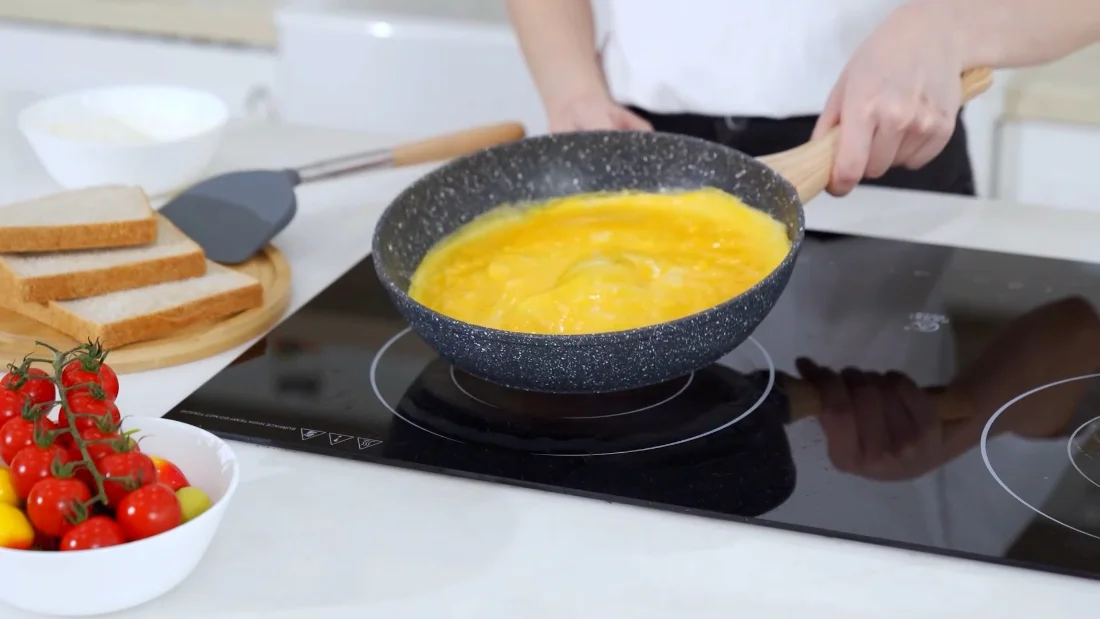
Every cookware claim eventually stands trial in front of an egg, so it is worth doing the trial properly. The pan is the 8-inch or 9.5-inch frying pan, whichever your set carries. The dial is a notch below medium. The fat is one teaspoon of oil or a small knob of butter added to the warm, not hot, pan. Crack the egg into a cup first, slide it in, and then do the difficult part: nothing. No shaking, no edging with the spatula, no anxious lifting. On an intact granite surface, the white sets, the edge laces slightly if you like it that way, and at the end the whole egg answers a gentle tilt of the pan by migrating to the plate on its own.
If the egg resists, the pan is telling you one of three things, and none of them is "buy a new pan." Either the surface was too hot, and the white bonded before it set, drop the dial a notch next time. Or the pan went in wet or cold, and the egg glued to a film of water, preheat that extra minute. Or a residue film is building, usually from cooking spray, and the surface wants the gentle reset described in our care guide. The egg is not breakfast. It is diagnostics you can eat.
Omelets scale the same physics. Low and slow, curds pushed toward the center with silicone while the pan does the setting, a lid for thirty seconds if you like the top fully done. The French technique that terrorizes line cooks on steel becomes genuinely forgiving on a release surface, and a Sunday cook can plate a respectable tri-fold by the second attempt.
The saucepan on low: milk, grains and patience
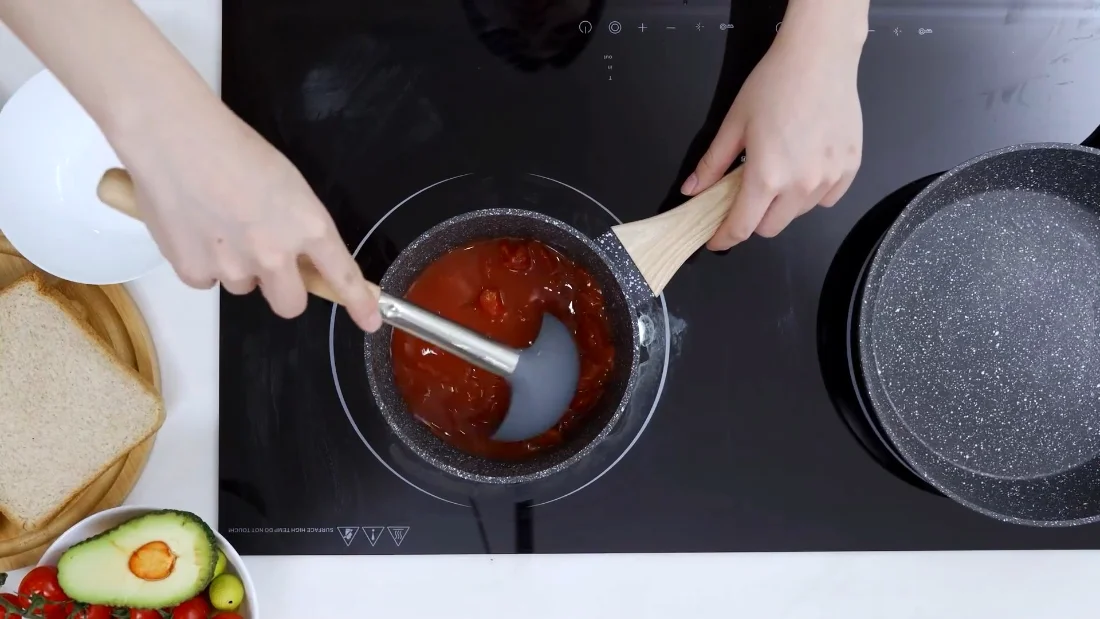
Frying gets the attention, but the saucepan jobs are where a coated pot changes the texture of a week. Milk is the classic tyrant: on a thin pot it scorches at the floor the moment attention wanders, and the scorch flavors everything above it. On a cast body over low heat, milk for cocoa or a bechamel warms evenly, and whatever film forms at the end wipes off with the sponge instead of soaking overnight.
Rice and grains follow the same logic. Toast the grain briefly in a slick of oil, add liquid, bring it to the boil on medium, then lid on and dial to low. The vented glass lid holds a simmer you can see, which is the entire secret of rice that neither burns nor boils over. Oatmeal, polenta, a caramel for the brave: everything that used to require a double boiler or a standing guard becomes a back-burner passenger. When the pot comes off, the release surface returns the last spoonful of polenta instead of keeping it as a souvenir, which is a small dignity that adds up over a hundred breakfasts.
The thermometer, not the clock
Nonstick cooking browns more gently than bare-metal cooking, and gentler color can mislead the eye that learned doneness from aggressive crusts. The honest fix costs a few dollars and lives in a drawer: an instant-read thermometer. The public reference chart is short enough to memorize, and it is the one we cook to in our own test kitchen.
| The food | Done at | Worth knowing |
|---|---|---|
| Whole cuts of beef, pork, lamb | 145°F, rest 3 minutes | The rest finishes the center, cutting early spills it |
| Ground meat, sausage | 160°F | Color is not a doneness signal in ground meat |
| All poultry | 165°F | Whole birds, pieces and ground alike |
| Fish | 145°F | Or when the flesh separates easily with a fork |
| Egg dishes | 160°F | Frittatas and quiches, set through |
| Leftovers | 165°F | Reheat fully, in the pan or the oven |
Those figures come from the federal food-safety chart linked below, read on the date shown. The thermometer habit also protects the pan: the cook who trusts the number does not compensate with a higher dial, and the coating lives longer at the temperatures the food actually needs.
Two rules the fire service repeats
Cooking is the leading cause of home fires in the United States, and the fire administration's own prevention page is blunt about the mechanics: the fires start when the cook leaves. So, rule one, printed on our test-kitchen wall: stand by your pan, and if you leave the kitchen, turn the burner off. Ninety seconds of reheating later is cheaper than everything the alternative costs.
Rule two is about geometry. Turn pot handles toward the back of the stove, so that a sleeve or a child cannot catch one. On our classic sets the wood-look handles make the habit comfortable, and on the pack-flat sets you can simply click the handle off a pot that is simmering unattended at the back. Keep a lid within reach while you fry, because the fire service's advice for a pan fire is to cover it, and a tempered glass lid you were already using is the fastest cover in the house. The full page, with the statistics, is in the source list, and it says more in a hundred words than most safety leaflets say in a thousand.
Mistakes that look like pan problems
Most complaints about nonstick pans describe the cook's habits with the pan as the defendant, so here is a short translation table from symptom to cause, collected from our own test kitchen's early mistakes as much as anyone's.
Food sticks in the center only: the pan was overheated, and proteins bonded before they set. The surface is fine. The dial was high. Food sticks at the shoulder in a ring: cooking-spray varnish, the amber residue sprays leave at the edge of the heat zone. Switch to poured oil and clean the ring gently. Pancakes brown in patches: the pan was not given its two preheating minutes, so the first pour landed on a gradient. The second batch always looks better, and with a full preheat the first one will too. Sauce reduces unevenly and spits: the burner is too large for the pot, wrapping flame up the walls. Match the pot to the burner and the walls stop cooking. The lid rattles and drips at the counter: that is the steam vent doing its job during a hard boil. Drop to a simmer and the lid settles.
None of these costs anything to fix, and together they cover nearly every disappointing evening a coated pan has ever been blamed for. The pattern behind them is one sentence long: the pan responds faster and needs less than the cookware you learned on, and the adjustment period is about a week of dinners.
A week on one set
Technique settles in fastest when the pan stays out of the cabinet, so here is a plain week from our own kitchens, cooked entirely on the twelve-piece granite set that leads SODAY cookware as a range. Monday: eggs and toast on the small frying pan, low heat, one teaspoon of oil, thirty-second cleanup. Tuesday: a stir-fry in the deep saute pan on medium, sauce finished in the same pan, glass lid on for the final steam. Wednesday: pasta in the casserole, sauce in the saucepan, the two burners the whole dinner needed. Thursday: salmon seared on medium in the big frying pan, thermometer to 145, pan wiped clean while the fish rests. Friday: pancakes on medium-low, edge browning matching the center, which is what a cast body with a full disc base is for.
Nothing in that week asked for talent. It asked for a dial held at medium, oil measured in teaspoons, a thermometer instead of a guess, and a cook who stayed in the room. That is the whole technique, and it is the reason a granite set treated this way still cooks like itself years in. When you are choosing which set to learn it on, the range table in our journal's care guide breaks down where each kitchen starts.
